
Prewrath Rapture Dot Com

February 26, 2007

Response to the "Discovery" of Jesus' Bone Box

On important occasions we will post non-eschatological articles from time to time that are germane to the Christian faith.

By now you have heard some news' outlets report that "a Canadian documentary filmmaker... has strong evidence a group of burial boxes unearthed in Jerusalem belonged to Jesus Christ and his family."

The following are links from the noted Evangelical apologist, James White. He is known for his robust instructive responses to these type of "Da Vinci Code" attempts to undermine the Christian faith.

I will also update this post with other beneficial instructive linked articles that refute the latest "The Lost Tomb of Jesus" story.

The Lost Tomb of Jesus

Oh Brother, Here We Go Again--or Do We?

Addenda:


More Outlandish Discovery Channel Claims

What to Say

Live Blogging Larry King

If There Was Ever An Unfair Fight, This Is It

Today on the DL (Dividing Line Radio Show)

Hollywood Hype: The Oscars and Jesus’ Family Tomb, What Do They Share? (Bock)

Posted by Alan Kurschner on 02/26/07 @ 10:21 AM
Filed under: Apologetics


February 18, 2007

Thessalonian Nuggets: 1Th 4:17a
The Dead in Christ will Rise First, but will not Meet Christ First

Here is a little exercise. Read the following verse from two different versions and look for a different meaning between the two in the sequence of events:


After that, we who are still alive and are left will be caught up together with them in the clouds to meet the Lord in the air. (1Th 4:17a NIV)

then we that are alive, that are left, shall together with them be caught up in the clouds, to meet the Lord in the air (1Th 4:17a ASV)

We are informed earlier that the dead in Christ are raised first. But in verse 17 do they meet Christ first in the clouds before those who are alive meet Christ?

Notice that in the first version (NIV) it suggests that the dead in Christ are already in the clouds with Christ and those who are alive follow after to meet Christ in the clouds.

The second version (ASV) suggests that the alive and the dead in Christ unite together first, and both at the same time then are caught up in the clouds to meet the Lord.

Which rendering is better?

In this text, Paul is more concerned with the sequence of events than he is in other discussions of the Coming (e.g. 1Cor. 15). He states in verse 16 that the dead in Christ will rise "first" (prośton). "First" of what? God's first divine purpose of the Coming (Parousia) will be to resurrect the dead in Christ. This must happen first before the next event.

Paul immediately turns his attention in verse 17 with "then" (epeita) in the next event of the sequence to those believers who are alive and remaining. He joins this group with the group of the dead in Christ who have been raised by using the important phrase, "together with" (hama syn).

I have provided you below the exact order of the Greek to demonstrate that Paul combines the two groups of believers before they are snatched up to meet the Lord:

epeita (Then) heśmeis (we) hoi zośntes (the living ones) hoi perileipomenoi (the ones remaining) hama syn (together with) autois (them [dead in Christ]) harpageśsometha (will be snatched away) en nephelais (in clouds) eis apanteśsin (to meet) tou kyriou (the Lord) eis aera (in air)

If you can follow the English order I provided in the text, you will see that the term hama syn (together with) joins these two groups, which are then subsequently snatched away. There are no Greek grammar rules that would have us to understand it differently.

Joseph Plevnik sums it up well,

The sequence of the these events is crucial. The first act at the Lord's coming from heaven is that the deceased faithful are brought back to life; then only, once they have been reunited with the living, is everyone taken up by the clouds to meet the Lord. These pointers ["first," "then," "together with"], clearly inserted by Paul himself, insist on this sequence of acts. The surviving faithful have no advantage over the deceased: the latter are brought to life, join the living, and are, together with the living, taken up by the clouds. (Paul and the Parousia: An Exegetical and Theological Investigation, p. 82)

And thus, Paul's teaching that the dead in Christ are not at a disadvantage in the future event of the Parousia of Christ, and this truth should have consoled the grief that the Thessalonians were experiencing.

The rapture does not include only those who are alive at the Parousia, but includes the newly risen "dead in Christ" as well. Once these two groups are united then they will both simultaneously be caught up to meet the Lord in the air.

Now, what happens afterwards once they meet the Lord in the air? Do they then go straight to heaven with Christ? Do they remain in the air for some indeterminate duration of time? Or do they immediately come back to the earth with Christ?

This is arguably one of the most vexing questions among premillennialists. And in the course of this Thessalonians series I will devote more than average time to answer this pivotal question.

Posted by Alan Kurschner on 02/18/07 @ 01:55 PM
Filed under: 1&2 Thessalonians


February 11, 2007

Thessalonian Nuggets:
Annotated Bibliography

bibliography.gif

As I will be posting articles on Thessalonians from time to time on the blog over the course of the year, I thought some of you may be interested in a bibliography on Thessalonians for any future study that you may want to embark on.

If you have any questions on this bibliography or other studies on Thessalonians, feel free to write me.

The Letters to the Thessalonians
by G. Green (Pillar; Grand Rapids: Eardmans, 2002.)

If there is only one commentary that should be read, it is this one. It is one of the more recent standard commentaries. Green is a specialist in the background of the Thessalonian epistles. But his commentary is not only excellent in that area, but in the exegesis and thematic discussions as well. The Pillar commentary series is an all-around excellent series.

For those interested in the history and archeology of Thessalonica, take the time to view Green's photos.

The First and Second Epistles to the Thessalonians
by E. Best (2nd ed.; BNTC; Peabody: Hendricksen, 1986)

1 and 2 Thessalonians by I.H. Marshal (NCBC; London: Marshall, Morgan and Scott, 1983; reprint: Vancouver: Regent College, 2002).

These latter two commentaries have been standard for the past two to three decades. They are both a bit more brief than Green's commentary, but you cannot go wrong with them.

From Hope to Despair in Thessalonica: Situating 1& 2 Thessalonians by C. R. Nicholl (SNTSMS; Cambridge University Press, 2004).

If you are very serious about Thessalonians study, then this work is a must have for your library. It is not a commentary per se; it is a monograph which comprises various discussions and research of subjects of recent scholarship.

Nicholl's appendix of his work contains his breakthrough article on his thesis of the identification of the "Restrainer" as Michael the archangel.

Further, you can find his thesis as well in an article in the Journal of Theological Studies 51 (2000): 27-53; Nicholl, C. R. 'Michael, the Restrainer Removed (2 Thess. 2:607).'

I trust that this bibliography will be sufficient. There are voluminous books, articles, etc., on the Thessalonian epistles, but the above is what I recommend for a comprehensive introduction to the letters.
Posted by Alan Kurschner on 02/11/07 @ 11:14 PM
Filed under: 1&2 Thessalonians


February 4, 2007

Thessalonian Nuggets:
Introduction

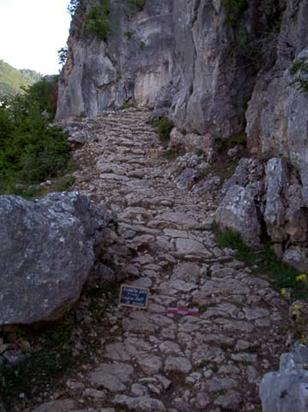
via ignatia.jpg

This is the first installment of what will be an in-depth study into the Thessalonian epistles. It will not be a verse-by-verse series per se, nor will it be simply a topical study. It will be both. At times I will discuss particular verses or small units of text, and at other times, there will be thematic discussion.

Some of the articles will be relevant to the Prewrath position, and some will deal with other theological, apologetic, devotional, and "critical" matters. For example, were you aware that the shortest verse in the New Testament is not "Jesus wept"? Ok...it is the shortest in the English Bible, but not in the Greek Bible. The shortest Greek verse is found in Thessalonians--and though it is very short, it is one of the most difficult teachings to apply to the Christian life. What is this verse you ask? You will have to be patience until that time!

For more of a sampling of what is to come this year in this series:

1) The traditional interpretation of the "idle" persons in 2Thess 3 is an eschatological explanation. But there is a more compelling reason that is due to a particular social dynamic in the Thessalonian church that causes some to be idle.

2) There are many who deny the concept of a "rapture" in 1Thess 4:17, "After that, we who are still alive and are left will be caught up together with them in the clouds to meet the Lord in the air. And so we will be with the Lord forever.

Yes, I know what you are saying, "How can the rapture be more explicit than that?" Well, there is a verb and phrase construction that you need to be aware of that some attempt to argue a different meaning into the text. You need to be aware of this argument, and know how to respond to it.

3) The mantra you hear today in the Evangelical church is, "Eschatology is not important" or "This doctrine should not divide people."

If that is the case, then why does the apostle Paul admonish believers in his conclusion of his teaching of the Second Coming with,

If anyone does not obey our instruction in this letter, take special note of him. Do not associate with him, in order that he may feel ashamed. Yet do not regard him as an enemy, but warn him as a brother.” (2Th 3:14-15 NIV)

Is Paul asserting that his teaching on the Second Coming is a touchstone of fellowship? This text will be responsibly engaged with biblically and in its context to find out what Paul means by this.

4) Most liberal Christians and non-Christians do not believe that the apostle Paul wrote 2Thessalonians. Learn why they would think this, and how to respond to it intelligibly .

5) Who is the Restrainer in 2Thess 2? One of the major exegetical breakthroughs in Thessalonian scholarship in the past five years have solved this enigmatic identity. I will introduce you to the scholar who has argued cogently that Michael the Archangel is the "Restrainer"; and possibly interview him for this series. His conclusions have been agreed upon by many Evangelical scholars, Thessalonian experts, and proponents of the postmill, amill, and premill positions--even world-renown Jewish scholars have confirmed his conclusions.

But his argument for his thesis speaks for itself, in that he demonstrates the exegesis of Daniel and Thessalonians, which are corroborated by Second Temple and Rabbinic literature which show that Michael was understood to have a role of "restraining evil."

6) There will be articles in this series explaining the historical, political, religious, socio-economic, and geographic context. This will be information that does shed light on some key texts.

7) And last but not least there will be articles in this series on Prewrath concerns, which will be interspersed. They will cover Paul's language of "Coming," "Day of the Lord," "man of lawlessness," "gathered to him," etc.

Again, all the above is just a sampling; there will be many more subjects and texts that I did not mention.

Thessalonians is very possibly the first written correspondance of Paul to a church (but Galatians is often strongly argued for preceding Thessalonians as the first). At any rate, I trust that you will prepare your mind and heart for a journey into two pivotal ancient letters and its teachings which should help us to conform to Christ more everyday, and prepare us for suffering in this lifetime--and glory in the next.

(*Photo above is the Via Egnatia, the Roman Road that Paul and his associates traveled when leaving Philippi to go to Thessalonica.)

Posted by Alan Kurschner on 02/ 4/07 @ 01:23 AM
Filed under: 1&2 Thessalonians